 Green Valley Golf Cart Repair
 Mobile Golf Cart Repair in Green Valley
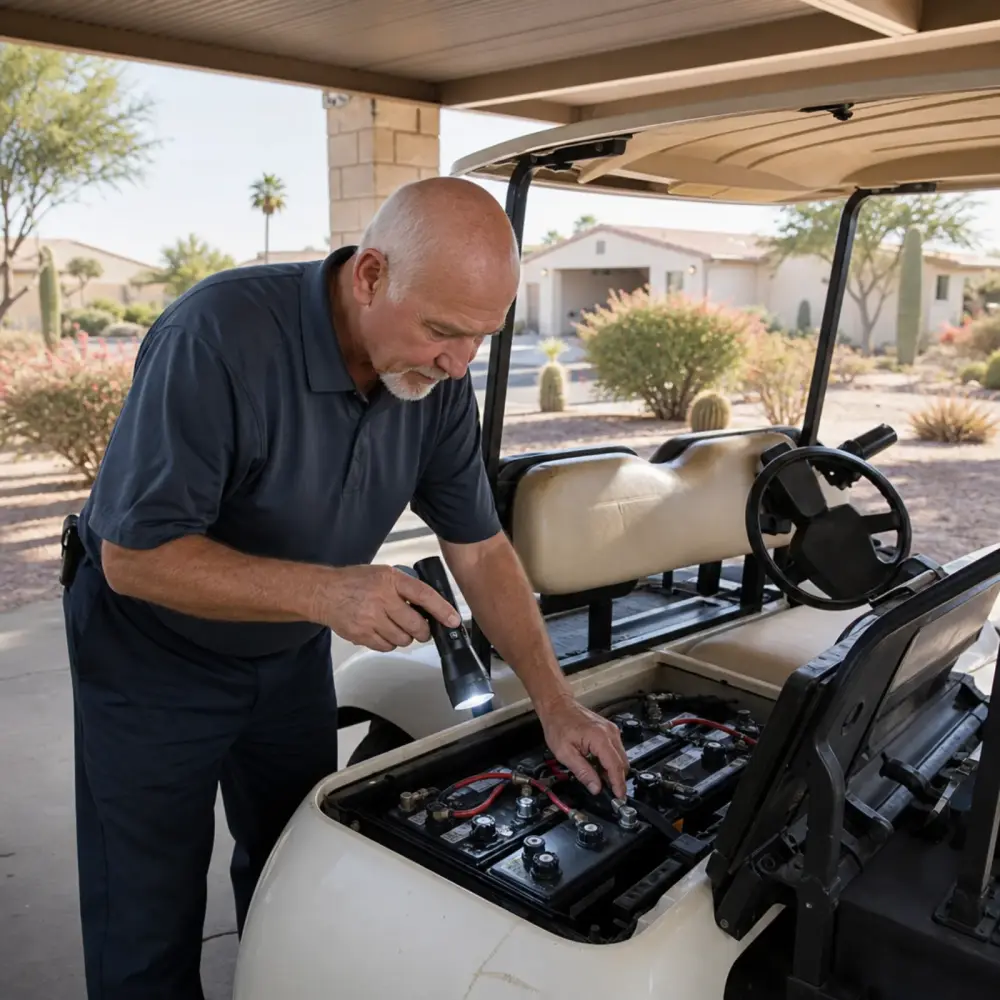
Green Valley Golf Cart Repair’s core service is exactly what it sounds like: a technician comes to your carport, garage, or driveway anywhere in Green Valley, diagnoses your cart on-site, and fixes it in the same visit whenever the parts are on the truck. The $50–$100 service call includes the diagnostic and is applied toward the repair, and most calls (dead packs, solenoids, brakes, tires, chargers) are one-visit jobs.
No trailering. That matters more here than almost anywhere. Green Valley is a community of dozens of HOA neighborhoods strung along the I-19 corridor, where the median age is about 73 and the cart is often a household’s primary vehicle: the ride to the GVR centers, to Green Valley Village on La Cañada Drive, to the course at San Ignacio or Torres Blancas. Most owners here have no truck, no trailer, and no interest in wrestling a 900-pound cart onto one to reach a shop in Tucson. So the shop comes to you.
What a mobile visit covers
The truck is stocked for the failures that actually strand carts in this valley:
- Won’t move at all: solenoid, controller, throttle input, or a pack too far gone to try. See motor and controller repair.
- Won’t charge: charger, charge port, corroded connections, or a pack that self-discharged below the charger’s start threshold over the summer. See charger repair.
- Weak, slow, or short range, usually batteries, sometimes cables or a dragging brake. See battery replacement.
- Brakes and tires: squeals, soft pedal, flats, dry-rotted sidewalls. See brakes and tires.
- Preventive service: watering, load tests, terminals, and the storage prep and wake-up work Green Valley’s snowbird calendar demands. See tune-up service.
All major brands (Club Car, E-Z-GO, Yamaha, ICON, Evolution) on both 36V and 48V platforms. We’re an independent service, not an authorized dealer for any manufacturer, and we’ll say so every time it matters.
How the visit runs
- Book with a symptom, not just an address. “Clicks but won’t move.” “Charger hums and quits.” “Dies halfway up the hill.” A good description usually narrows the fault to two or three suspects, and the tech loads the truck accordingly.
- Scheduled window at your home. Carport, garage, driveway, or an HOA’s cart parking, wherever the cart is. If it died away from home, on a cart path or at a rec center lot, tell us where; we can usually meet the cart where it sits.
- Real diagnosis before any recommendation. This is the part competitors skip. Each battery gets an individual load test, pack voltage alone hides a single failed battery. Flooded packs get specific-gravity readings with a hydrometer, cell by cell. The charger gets an output test under load. The solenoid gets checked for click, contact, and voltage drop across the terminals. Only after the fault is isolated do you hear a price.
- Flat quote, then the fix. Battery sets, solenoids, brake shoes, common tires, cables, and chargers ride on the truck, so approval usually means same-visit completion.
- Finish clean. Watering, terminal cleaning and protectant, torque check, test drive, and old parts and cores hauled away.
The Green Valley failure calendar
Mobile repair here has seasons, and it helps to know which one you’re in.
Summer (May–September) is when the damage happens. Extreme heat evaporates electrolyte out of flooded batteries and roughly doubles self-discharge; monsoon storms from mid-June on add power surges that quietly kill chargers. Carts still in service need monthly watering; carts parked for the summer need storage prep: a full charge, watered cells, and ideally a maintained charge while the owner is away.
October–November is when the damage shows up. Winter residents return (the community swells from around 21,000 people to roughly 30,000) and thousands of carts that sat since spring get their first turn of the key. The ones that were stored right start fine. The rest generate our busiest weeks of the year: chargers that won’t engage a deeply discharged pack, sulfated batteries, seized brake hardware, flat and cracked tires.
Winter and spring are riding season, the Santa Rita foothills weather Green Valley was built for, and the calls shift to wear items: brakes, tires, and the packs that limped through one October too many.
Who calls us
Mostly homeowners with one cart under the carport. But the working carts of the valley are on the schedule too: HOA patrol and courtesy carts that cycle daily across the larger subdivisions, golf course maintenance and range carts doing full-load duty in full sun, and guest carts at seasonal rentals that need to be right before visitors arrive. Fleet and multi-cart owners can put recurring tune-ups on a schedule so problems surface at the watering check, not on a cart path.
What it costs
The trip fee is $50–$100 anywhere in the service area and comes off the bill when you approve the repair. Beyond that, every job we do has a published range, packs $1,200–$1,800, solenoids $100–$250, brakes $75–$400, tires $75–$150 each, all listed on the pricing page. Quotes are flat and given before work starts. If the honest answer is “don’t fix this cart,” you’ll hear that instead, and the trip fee is all you’ll pay.
Book a visit
Tell us the brand, gas or electric, the battery count if you can see it, and the symptom, a photo of the battery compartment or the dash helps more than you’d think. We’ll give you a likely range on the spot and a scheduling window, usually same-day or next-day across Green Valley, Sahuarita, and Quail Creek, and next-day out to Corona de Tucson and Tubac.
Frequently Asked Questions
What does 'mobile' actually mean, what can you fix on-site?
Almost everything a cart shop can: battery packs, solenoids, controllers, chargers and charge ports, brakes, tires, cables, lights, and most drive-system work. The truck carries the common parts, so most repairs finish in one visit. The rare job that needs bench work, we'll tell you up front.
How much is the visit?
$50–$100 depending on where you are between Sahuarita and Tubac, including the full on-site diagnostic. Approve the repair and the fee is applied toward the work.
How fast can you come?
Same-day or next-day for most of Green Valley, Sahuarita, and Quail Creek. Describe the symptom when you book, most problems narrow down from a good description, so the tech arrives with the likely parts.
Do you work on both 36V and 48V carts?
Yes, and telling them apart is easy: count the batteries. Six 6-volt batteries is a 36V cart, six 8-volts or four 12-volts is 48V. We service all the common electric platforms from Club Car, E-Z-GO, Yamaha, ICON, and Evolution.
Is there anything you won't work on?
We don't do factory warranty work. We're independent, not an authorized dealer, so in-warranty repairs belong with your selling dealer. Beyond that, if a repair isn't worth doing against the cart's value, we'll say so rather than take the job.